×
× 



Unit 8 Tiếng Anh lớp 11 sách Global Success với chủ đề Becoming Independent (Trở nên độc lập) giúp học sinh tìm hiểu về các kỹ năng sống cần thiết để trở thành người trẻ độc lập, tự chủ và có trách nhiệm với bản thân cũng như gia đình.
Bài viết tổng hợp đầy đủ đáp án và gợi ý trả lời cho tất cả các hoạt động trong unit, giúp các bạn học sinh lớp 11 củng cố kiến thức và đạt kết quả cao trong học tập.
Phần mở đầu là cuộc hội thoại giữa Nam, Mai và Mark về việc giành được sự tin tưởng của cha mẹ và các kỹ năng cần thiết để trở nên độc lập,.
Đáp án:
| Mai | Nam | Mark | |
| 1. Managing money | ✓ | ||
| 2. Cooking, cleaning, and doing laundry | ✓ | ||
| 3. Managing time | ✓ |
Đáp án:
1. confidence - a belief in your own ability to do things well
2. independent - confident and free to do things without help from other people
3. responsibilities - things that you must do as part of your duty or job
4. money-management - the activity of planning how to spend and save money
Đáp án:
1 - d: It's my mum who's calling me again.
2 - a: It was earning my parents' trust that took a long time.
3 - b: It's my parents who still think I don't have the skills to be independent.
4 - c: It's the app that taught me how to be responsible with money.
👉 Xem chi tiết: Tiếng Anh 11 Unit 8 Getting Started
Phần phát âm Unit 8 giới thiệu về ngữ điệu (intonation) trong lời mời, gợi ý và yêu cầu lịch sự.
1. Listen and repeat. Pay attention to the fall-rise intonation (⤻) in the following sentences
1. Would you like a cup of tea? ⤻
2. Why don't you answer your phone? ⤻
3. Would you like me to help you install the software? ⤻
4. Can you show me the money-management app you told me about? ⤻
Lưu ý: Dấu ⤻ thể hiện ngữ điệu giảm rồi tăng nhẹ ở cuối câu, tạo cảm giác thân thiện và lịch sự.
2. Listen and pay attention to the fall-rise intonation in the following sentences. Then practise saying them in pairs
1. Shall we now talk about other learning methods? ⤻
2. Could you please pay attention when I'm talking to you? ⤻
3. Why don't we use public transport to go to school? ⤻
4. Would you like to join our cooking course? ⤻
Phần từ vựng Unit 8 tập trung vào các từ và cụm từ liên quan đến sự độc lập của thanh thiếu niên.
1. Match the words with their meanings
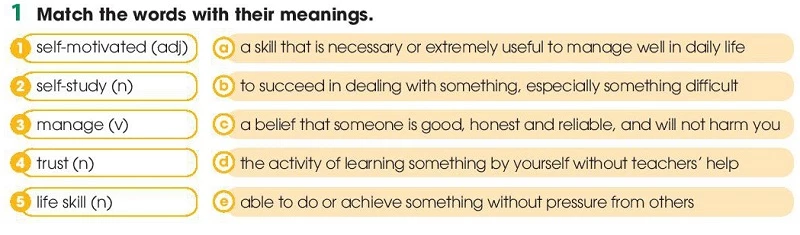
1 - e: self-motivated (adj) = able to do or achieve something without pressure from others
2 - d: self-study (n) = the activity of learning something by yourself without teachers' help
3 - b: manage (v) = to succeed in dealing with something, especially something difficult
4 - c: trust (n) = a belief that someone is good, honest and reliable, and will not harm you
5 - a: life skill (n) = a skill that is necessary or extremely useful to manage well in daily life
2. Complete the sentences using the correct form of the words in 1
1. We have great trust in our parents and teachers.
2. Teenagers should learn basic life skills, such as cooking a meal and using a washing machine.
3. My brother signed up for a self-study computer course.
4. It is important for us to learn how to manage our time and money.
5. His parents don't have to force him to study hard as he is highly self-motivated.
Phần ngữ pháp Unit 8 giới thiệu về câu chẻ (Cleft sentences) - một cấu trúc ngữ pháp giúp nhấn mạnh một phần cụ thể của câu.
1. Rewrite the sentences using cleft sentences focusing on the underlined parts
1. John is saving his pocket money to buy a new phone.
→ It is John who/that is saving his pocket money to buy a new phone.
2. He gets 20 dollars every week by doing chores around the house.
→ It is 20 dollars that he gets every week by doing chores around the house.
3. John earned more pocket money by helping his grandpa last weekend.
→ It was last weekend that John earned more pocket money by helping his grandpa.
4. He bought gifts for his friends and family members with his pocket money.
→ It was gifts for his friends and family members that he bought with his pocket money.
5. Teenagers can earn pocket money by doing part-time jobs.
→ It is by doing part-time jobs that teenagers can earn pocket money.
2. Work in pairs. Ask and answer questions about the chores you and your family members do at home. Use cleft sentences
Gợi ý trả lời:
Mẫu 1:
A: Is it you who washes the dishes after meals?
B: No, it is my younger brother who washes the dishes. I usually cook, so he helps with the cleaning.
A: What about doing the laundry? Is it your mother who does it?
B: Yes, it is my mum who does most of the laundry, but it is me who hangs the clothes out to dry.
Mẫu 2:
A: Is it your dad who takes out the rubbish?
B: Yes, it is my dad who takes out the rubbish every morning before going to work.
A: Who vacuums the house? Is it you?
B: No, it is my sister who vacuums the house on weekends. It is me who sweeps the floor on weekdays.
👉 Xem chi tiết: Tiếng Anh 11 Unit 8 Language
Bài đọc Unit 8 giới thiệu về những kỹ năng cần thiết để thanh thiếu niên trở nên độc lập, bao gồm quản lý thời gian, quản lý tiền bạc, kỹ năng ra quyết định và các kỹ năng sống cơ bản.
Hoạt động này cho phép học sinh tự đánh giá mức độ độc lập của bản thân thông qua một bảng câu hỏi. Nếu tổng điểm của bạn là 9 trở lên, bạn là người độc lập.
| How often do you ...? | Always (3 points) | Sometimes (2 points) | Never (1 point) |
| 1. go to school by yourself | |||
| 2. cook meals for your family | |||
| 3. communicate well with people | |||
| 4. think carefully before making decisions | |||
| 5. plan how to save and spend your pocket money |
Đáp án:
A - 5: Learn basic, but important life skills
B - 4: Improve your decision-making skill
C - 3: Develop time-management skills
Đáp án:
1 - c: get around = to go or travel to different places
2 - e: come up with = to produce or find an answer or a solution
3 - b: carry out = to perform and complete something
4 - d: get into the habit of = to start doing something regularly so that it becomes a habit
5 - a: make use of = to use something to achieve a particular result or benefit
Decision-making skills:
Identify the problem → Think of (1) many solutions → Review pros and cons → Pick the (2) best option → Create and carry out your plan
Time-management skills:
Make (3) a to-do-list → Use time-management tools → Do one thing at a time → Schedule time to relax → Have a good (4) night's sleep
Which of the skills mentioned in the text do you have? What other skills do you think teenagers need to become independent?
Gợi ý thảo luận:
A: Which of the skills mentioned in the text do you have?
B: I think I have good time-management skills. I always make a to-do-list and use a planner app to organize my tasks. But I need to improve my decision-making skills because I sometimes make choices based on emotion.
A: That's good! What other skills do you think teenagers need to become independent?
B: I believe digital literacy is very important nowadays. We need to know how to use technology safely and protect our personal information online. Also, emotional intelligence helps us manage our feelings and build better relationships with others.
👉 Xem chi tiết: Tiếng Anh 11 Unit 8 Reading
Phần Speaking Unit 8 tập trung vào kỹ năng đưa ra hướng dẫn chi tiết về các kỹ năng sống cơ bản, đặc biệt là việc giặt giũ.
a. Have you ever done your laundry? If yes, how did you do it?
Sample 1:
Yes, I have done my laundry several times. First, I sort my clothes by colour, separating whites and colours. Then I add the washing powder or liquid to the machine, load the clothes, and select the appropriate washing cycle. After the machine finishes, I hang the clothes outside to dry. Finally, I fold them and put them away in the wardrobe.
Sample 2:
Yes, I do my laundry regularly. I usually use the washing machine. First, I check all pockets and separate dark clothes from light ones. Then I put them in the washing machine with detergent, select the right temperature, and start the cycle. When it's done, I either hang them to air-dry or use the dryer if I'm in a hurry.
b. Below are some steps to do laundry. Put them in the correct order.
1. B - Sort the clothes by colour
2. D - Add the washing powder or liquid
3. E - Load the washing machine and turn it on
4. C - Remove the wet clothes from the washing machine and dry them
5. A - Hang or fold, and store your own clothes
Đáp án:
There are several simple steps in doing laundry. First of all, (1) sort your clothes by colour. You should separate them into whites and colours, and wash them separately. (2) Secondly, add washing powder or liquid. Read the instructions on the packet to make sure you use the right amount. Then, (3) load the washing machine and turn it on. Make sure you place the items one at a time. Don't put too many items as they need room to move about in the water. When the washing machine stops, (4) remove the wet clothes. You can hang the items to dry, or put them in the dryer. Remember that air-drying clothes saves energy and money. (5) Finally, don't forget to hang or fold each item. You could also iron your clothes before storing them in the wardrobe or drawer.
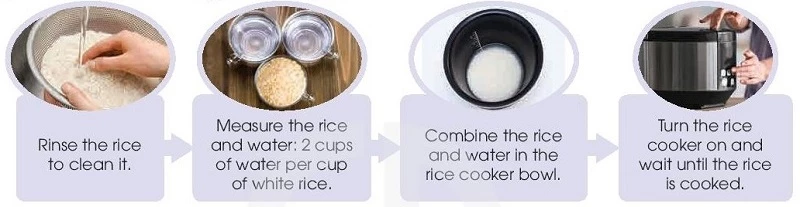
Gợi ý trả lời:
Cooking rice in a rice cooker is very simple if you follow these steps carefully.
First of all, rinse the rice thoroughly to clean it. You should wash it at least 2-3 times until the water runs clear. This removes excess starch and makes the rice less sticky.
Secondly, measure the rice and water carefully. The standard ratio is 2 cups of water per cup of white rice. Make sure you use the measuring cup that comes with your rice cooker for accuracy.
Then, combine the rice and water in the rice cooker bowl. Don't forget to level the rice evenly in the bowl. After that, place the bowl inside the rice cooker and close the lid properly.
Finally, turn the rice cooker on and select the appropriate cooking mode and wait until the rice is cooked.
Hoạt động này khuyến khích học sinh làm việc nhóm để bổ sung thêm các bước hoặc mẹo nấu cơm và trình bày trước lớp.
👉 Xem chi tiết: Tiếng Anh 11 Unit 8 Speaking
Phần Listening Unit 8 giới thiệu về khái niệm người học độc lập (independent learner) và các đặc điểm của những người học có khả năng tự học hiệu quả.
Đây là bài tập tự đánh giá cá nhân, mỗi học sinh có thể có câu trả lời khác nhau tùy theo đặc điểm bản thân.
| Yes | No | |
| 1. Are you interested in learning new things? | ||
| 2. Do you set your learning goals and make plans to achieve them? | ||
| 3. Do you try to understand a problem on your own before asking for help? | ||
| 4. Do you want to know more about the world? |
Đáp án:
1. What is the conversation mainly about?
→ C. What makes a successful independent learner.
2. What makes independent learners study hard?
→ A. Their motivation for learning.
3. What do independent learners do if the task they are working on is too difficult?
→ B. They make every effort to finish it.
4. Which of the following descriptions of independent learners is NOT mentioned?
→ B. They're confident and highly organised.
Đáp án:
1. How many characteristics of independent learners does Mike find on the website?
→ Four / 4 (characteristics)
2. What do independent learners take responsibility for?
→ Their own learning
3. What do they use to help them achieve their learning goals?
→ Detailed study plans
4. What are they not afraid of doing?
→ Asking difficult questions
Which of the characteristics of independent learners do you think you have? Which one do you want to develop in the future?
Gợi ý trả lời:
I think I have some characteristics of an independent learner. First, I'm quite curious about the world and always want to learn new things, especially about science and technology. I also try to understand problems on my own before asking for help from teachers or friends.
However, I want to develop my sense of responsibility more in the future. Sometimes I find it difficult to set clear learning goals and make detailed study plans. I also need to improve my perseverance - I tend to give up quite easily when facing difficult tasks. In the future, I want to become more self-motivated and never give up, even when the work is challenging.
👉 Xem chi tiết: Tiếng Anh 11 Unit 8 Listening
Phần Writing Unit 8 hướng dẫn học sinh viết một bài báo phân tích ưu và nhược điểm của việc tự học.
Đáp án:
| Pros | Cons | |
| 1. Self-study gives learners more freedom (e.g. they decide what to study and how). | ✓ | |
| 2. Learners need more time to learn things (e.g. they work on their own, with no one to push them or help them). | ✓ | |
| 3. Learners become responsible (e.g. they set their learning goals and make plans to achieve them). | ✓ | |
| 4. Learners may not develop certain life skills (e.g. good communication and relationship skills). | ✓ | |
| 5. Self-study makes learners confident (e.g. they realise they can complete tasks by themselves). | ✓ | |
| 6. Learners may not learn practical skills (e.g. they may focus too much on learning, and may not apply the academic skills to real life). | ✓ |
Các ý tưởng bổ sung:
| Pros (Ưu điểm) | Cons (Nhược điểm) |
| Flexible schedule: Learners can study at their own pace and at times that suit them best. | Lack of interaction: Learners miss out on discussions and collaborative learning with peers. |
| Cost-effective: Self-study often requires fewer financial resources compared to formal education. | Difficulty staying motivated: Without external pressure or support, learners may lose motivation easily. |
| Personalized learning: Learners can focus on topics they find challenging and skip what they already know. | Limited feedback: Learners may not receive timely corrections or guidance on their mistakes. |
Title: Pros and cons of self-study
Introduction:
Body paragraphs:
Conclusion:
👉 Xem bài mẫu chi tiết: Tiếng Anh 11 Unit 8 Writing
Phần Everyday English giới thiệu cách bày tỏ lời chúc tốt đẹp và cách phản hồi trong các tình huống giao tiếp hàng ngày.
1. Listen and complete the conversations with the expressions in the box. Then practise them in pairs
Conversation 1:
Nam: Hey, I heard that you're going on a trip to Singapore tomorrow. (1) B. Have a great time!
Mike: Yep. (2) D. Thanks so much.
Conversation 2:
Kevin: Hi, Mai. (3) C. Happy New Year! I Wishing you a great year ahead!
Mai: Thanks, Kevin. (4) A. Same to you! Hope all your dreams come true!
2. Work in pairs. Use the models in 1 to make similar conversations for these situations. One of you is Student A, the other is Student B. Use the expressions below to help you
Gợi ý hội thoại:
Situation 1: Student A is going to take an exam. Student B is expressing his/her wishes for Student A's success.
Student B: Hey! I heard you're taking the university entrance exam tomorrow. Best wishes! I hope you do really well!
Student A: Thanks so much! I've been studying really hard for this.
Student B: I'm sure you'll ace it! I wish you every success in your exam.
Student A: Thank you for your wishes. That really means a lot to me.
Student B: You've got this! Good luck tomorrow!
Student A: Thanks! I'll do my best.
Situation 2: Student B is not feeling well. Student A is expressing his/her wishes for Student B's recovery.
Student A: Hi! I heard you've been sick. How are you feeling now?
Student B: Not great, actually. I've had a bad cold for the past few days.
Student A: Oh no, I'm sorry to hear that. Get well soon! I hope you feel better soon and make a speedy recovery.
Student B: Thanks so much. That's really kind of you to say.
Student A: Make sure you rest well and drink plenty of water. Take care of yourself!
Student B: I will. Thank you for your concern.
Student A: I hope to see you back at school soon!
Student B: Thanks! Hopefully, I'll be better by next week.
1. Read the text below and complete the diagram. Use no more than THREE words for each gap
Đáp án:
(1) English
(2) sports, clubs
(3) fast-food restaurants
(4) local hospitals
2. Work in groups. Discuss the following questions
Do American teenagers learn to become independent in the same way as Vietnamese teenagers? What are the similarities and differences?
Gợi ý trả lời:
Similarities:
Differences:
👉 Xem chi tiết: Tiếng Anh 11 Unit 8 Communication and Culture
Read the sentences using fall-rise intonation (⤻). Then listen and compare. Practise saying them in pairs
1. Shall we look for a part-time job to earn some pocket money?
2. Do you feel like doing a vegetarian cooking course?
3. Would you please give me some advice on how to set my goals?
4. Could you help me improve my communication skills?
Choose the correct answers A, B, or C to complete the sentences
Đáp án:
1. A. manage
2. A. self-motivated
3. C. life skills
4. B. time-management
Complete the answers to these questions using cleft sentences focusing on the words or phrases in brackets
Đáp án:
1. Would you like to apply for the babysitting job? (dog walking)
→ No. It is dog walking that I'd like to apply for.
2. Did your dad buy you a new bicycle last week? (a new motorbike)
→ No. It was a new motorbike that he bought me last week.
3. Is Lan the best decision-maker in your class? (Tuan)
→ No. It is Tuan who/that is the best decision-maker in my class.
4. Does the presentation skills training start tomorrow? (the day after tomorrow)
→ No. It is the day after tomorrow that the presentation skills training starts.
👉 Xem chi tiết: Tiếng Anh 11 Unit 8 Looking Back
Work in groups. Choose a life skill teenagers need to develop in order to become independent. Discuss what they need to do and make a list of all the steps and activities.
Present your group's plan to the whole class. Use these questions as cues for your presentation:
1. What is the life skill?
2. How important is it for teens to become independent?
3. What are the main steps of the skill development?
4. What other activities will be helpful for its development?
👉 Xem bài mẫu chi tiết: Tiếng Anh 11 Unit 8 Project
Unit 8 Tiếng Anh lớp 11 về chủ đề Becoming Independent đã cung cấp cho học sinh những kiến thức quý báu về các kỹ năng cần thiết để trở thành người trẻ độc lập, tự chủ và có trách nhiệm.
Mong rằng phần đáp án và gợi ý trả lời từ IELTS LangGo sẽ giúp các bạn hiểu rõ nội dung các bài học và vận dụng hiệu quả trong các bài kiểm tra cũng như trong cuộc sống thực tế.




ĐẶT LỊCH TƯ VẤN MIỄN PHÍ LỘ TRÌNH Săn ƯU ĐÃI lên tới 12.000.000đ